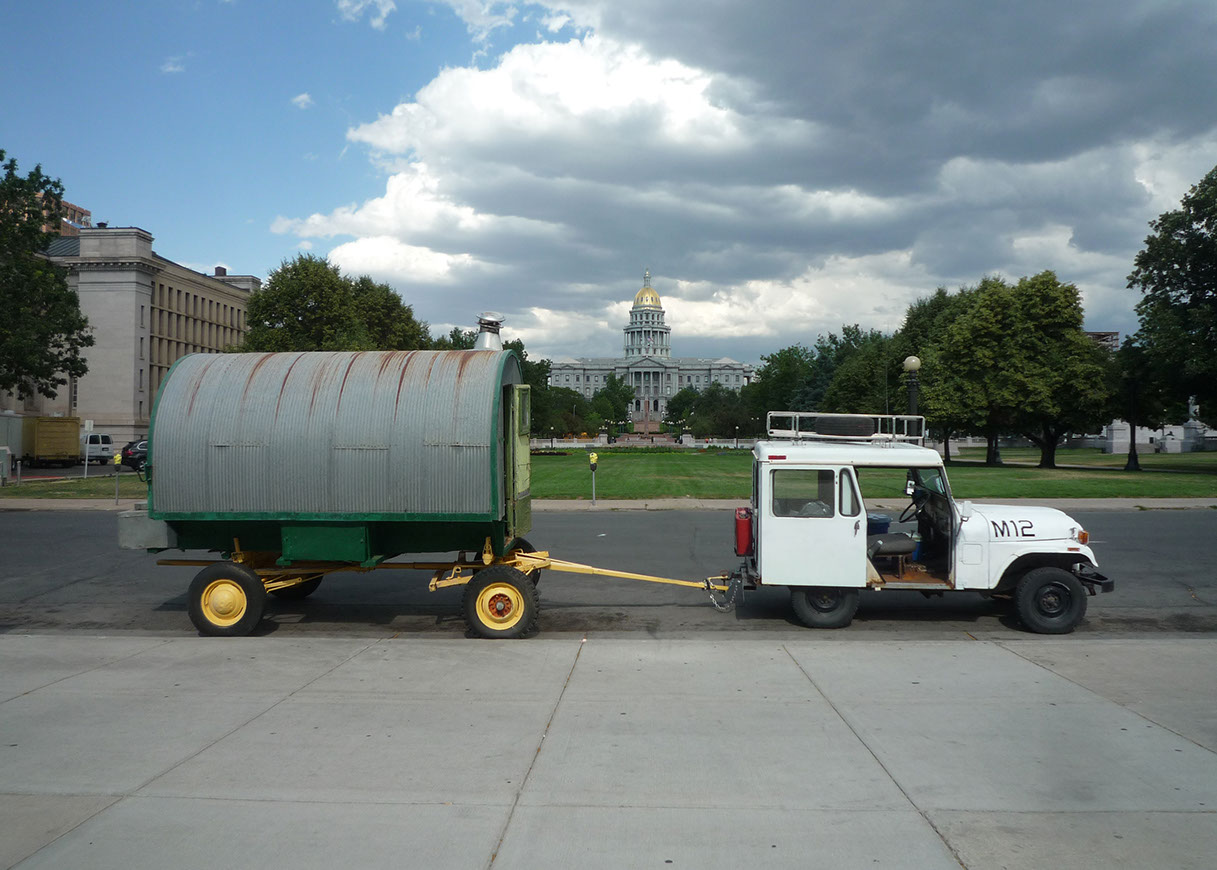
Campito. Denver and the Western Slope, Colorado. 2010

Campito is an urban intervention and social research project that includes a research portfolio and media documents for distribution. Parking spaces throughout the city of Denver were occupied during the Biennial of the Americas as a commissioned project by M12. The artists situated a sheep wagon and teams of community members and project volunteers throughout the city. Posters were given for free to all who interacted with the project and dialogue was created with both community members and national dignitaries from Central and South America who were in attendance for the Biennial of the Americas.

Campito focuses on investigative strategies for mobile architecture, landscape, collaboration, and social responsibility pertaining to the Western American sheep wagon or “campito”. The goal for this project was to thoroughly study the past and current design principles employed by sheep wagons, research the conditions in and around the structure, and ultimately redesign a number of prototypes for what a sheep wagon could become in the 21st century.

Sheep wagons have for the most part been surviving on a design philosophy developed at the end of the 19th century; a slightly evolved version of the covered wagon of pioneer times. Campito explores inventive designs for a mobile dwelling unit based on the experiences and activities of the contemporary sheepherder. A series of conceptual designs play with the dualistic qualities of the sheep wagon—freedom and standardization, art and science, structure and spontaneity, and the vast nature of perpetual unresolved conflicts of cultural heritage and human treatment. Each design includes the addition of a solar energy platform, a composting toilet and heated shower, global communications system, fire escape, and a portable garden for fresh vegetables.

The urban parking space interventions and public media distributions were aimed at stimulating community dialogue about the campito and larger subjects inherently tied to its present day reality—heritage of the American West, contemporary agriculture and food production, globalization, immigration, workers rights, and federal policies and practices. The project fuses contemporary, historical and geographical knowledge with the intention of putting it to use on the future Western American landscape. The series of conceptual designs explore the dualistic qualities of the sheep wagon—freedom and standardization, art and science, structure and spontaneity, and the vast nature of perpetual unresolved conflicts of cultural heritage and human treatment. Each design (distributed through posters and public dialogues) includes the addition of a solar energy platform, a composting toilet and heated shower, global communications system, fire escape, and a portable garden for fresh vegetables.

Support given in-part by; Denver Office of Cultural Affairs; The University of Colorado at Boulder; Zeppelin Development; The Colorado Wool Growers Association—Jake Carpenter, Steve Levalley, Jennifer Lee, Thomas Acker, Ignacio Alvarado.

Press coverage:
Connecting, disconnecting and intersecting at the Biennial of the Americas Denver, Colorado USA. July 8-13 2010 By Annalee Davis
Art Daily
Seattle Times
MSN—Canada
Art Ltd.
Idaho Mountain Express
The Western Star—Canada